

Why Transport Planning Optimization Has Become a Strategic Lever for Cost Reduction
Rising energy prices, geopolitical tensions disrupting trade routes, driver and capacity shortages: transport departments have little room left to maneuver, and the traditional levers for cutting costs are reaching their limits. In this environment, optimizing transport plans stands out as a more sustainable alternative to simple rate negotiation.
I - The limits of traditional levers
Faced with rising costs, the first reflex is often to renegotiate rates with carriers. Securing a few points of discount, putting providers back into competition, or revisiting framework contracts can generate short-term savings. But this approach quickly reaches its limits.
Carriers themselves are grappling with rising fuel prices, driver shortages, and increasing operating costs. Their ability to absorb further rate cuts is therefore increasingly limited. Over time, excessive pressure on prices can weaken the relationship with providers, degrade service quality, or restrict access to capacity when demand increases.
Above all, this strategy does not address the real source of the extra costs. Negotiation only acts on the purchase price of a service, without questioning how routes are built, vehicles loaded, or resources used. The resulting savings therefore remain limited, while the main performance gains often lie in the organization of transport itself.
II - The hidden costs of poor planning
A significant share of transport costs does not come from the rate negotiated with carriers, but from the inefficiencies generated by suboptimal planning. Because they are scattered across day-to-day operations, these losses often remain largely invisible in performance dashboards.
The most common situations are well known: partially loaded vehicles, empty kilometers driven between two deliveries, unbalanced routes, resources mobilized unevenly from one day to the next, or last-minute outsourced freight, generally more expensive for lack of anticipation.
Taken in isolation, each of these inefficiencies may seem marginal. Added up across hundreds, or even thousands, of routes, they nonetheless represent a significant share of the transport budget and directly reduce profitability.
The real issue is therefore not just the cost per kilometer, but the efficiency with which each resource is used. This is precisely where transport plan optimization creates the most value.
III - Creating value through optimization
Transport plan optimization relies on a different logic: rather than seeking to pay less for the same transport, it aims to transport better with the same resources, or even with fewer.
In concrete terms, this translates into fewer trucks mobilized thanks to better load saturation, fewer kilometers driven by limiting empty runs, and therefore a fuel bill that decreases mechanically. It also means a more robust plan, able to absorb a delay, a cancellation, or an order spike, without systematically resorting to emergency outsourced freight.
The difference is fundamental: rate negotiation acts on the unit price, optimization acts on the volume of resources consumed, and therefore on the overall cost of transport. The second lever is structurally more powerful and more sustainable.
IV - The value of a transport optimization solver
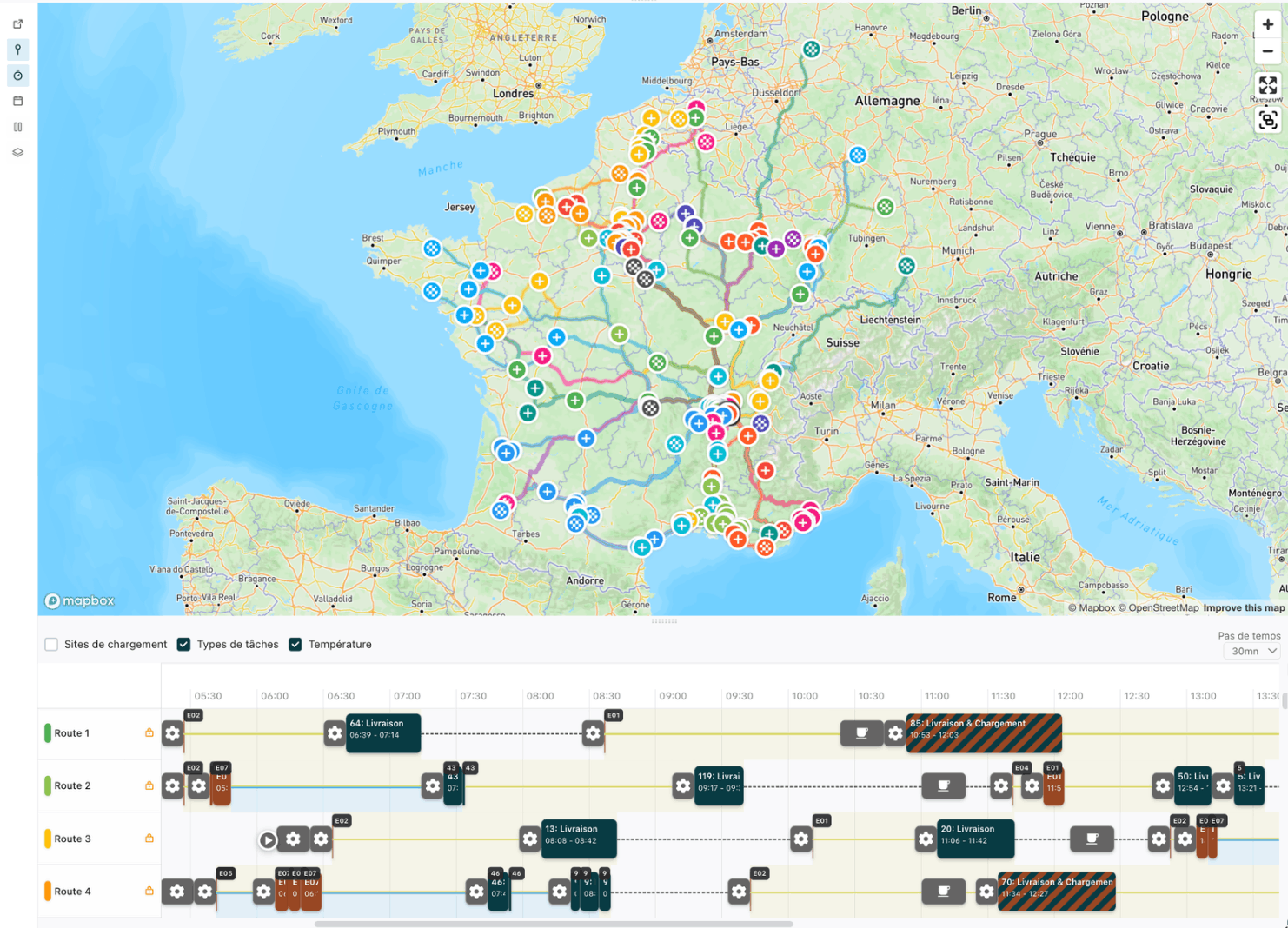
Route optimization tools make this approach accessible on a daily basis, no longer reserved for a one-off audit. They make it possible to simulate scenarios to compare several route configurations before committing, to re-optimize plans daily based on actual orders and the day’s disruptions, and to propose automatic trade-offs between cost, lead time, and service rate.
This shift in scale transforms optimization: from a one-off, manual exercise, it becomes a continuous process, integrated into the day-to-day operational management of transport.
In a context where the fixed costs of road transport dominate and the room for maneuver on rate negotiation shrinks, the real lever of competitiveness is no longer lower prices, but the intelligent and optimal use of available resources. Companies that invest today in optimizing their transport plans are building a lasting competitive advantage. Those that limit themselves to renegotiating their rates, on the other hand, remain exposed to the next round of price increases.