
Decision-Making AI in Supply Chain: Impact & Implementation

I- Decision-Making AI: From Predictive to Prescriptive
A. Many AIs - not just one
Artificial Intelligence in the supply chain comes in many forms. It can be used for forecasting, simulation, anomaly detection and alerting, or decision-making. This last category—decision-making AI—is still the least common, but it’s also the one with the biggest impact on operational performance, both economically and environmentally.
These approaches are complementary and often reinforce each other. For example, a high probability of stock storage calculated based on historical data can enhance a production planning decision by integrating this risk. Because they serve different goals, you can prioritize deployments based on your maturity level and business challenges (see Part II).
B. Prescribing an action plan rather than predicting a scenario
Most AI models rely on learning methods — more or less advanced — often related to Machine Learning. They typically process and analyze historical data to describe what happened, diagnose why it happened, or predict what might happen next.
Decision-making AI is different: it belongs to prescriptive analytics. Instead of stopping at insight or prediction, it recommends what to do. Powered by mathematical optimization, it produces not a probability or a scenario, but a concrete, actionable plan that can be implemented directly.

C. Optimization solvers: how do they work?
In practice, prescriptive decision-making AI often takes the form of optimization solvers — software engines designed to solve complex operations planning problems. The easiest way to understand them is through what they take in, what they produce, and what they model internally in terms of constraints and objectives.

Because they don’t need historical data to perform well, optimization solvers require the least amount of data — only the data strictly necessary for solving the problem:
- Input: a set of tasks to be carried out and the resources available.
- Output: an optimal plan that assigns tasks to resources—in other words: who does what, when, and in what sequence.
Inside the solver sits a digital twin of your problem: a mathematical model that captures your parameters, rules, constraints, and objectives. This model — fully customizable — can then be solved using powerful algorithms that compute the best solution in seconds.
An optimization solver is therefore a true decision-support tool. As the situation changes (data, constraints, objectives, parameters, etc.), it can recompute the best solution among billions of possibilities.
D. Supply-chain applications for optimization solvers
Optimization solvers can be applied across the supply chain — at each stage independently, but even more powerfully by synchronizing supply chain decisions within a systemic optimization approach.
Typical solver use cases in Supply Chain include:
- Transportation and distribution routing plan (RouteSolver)
- Palletization and 3D loading of trucks/containers (PackSolver)
- Picking, Batching, and Slotting in warehouses (PickSolver)
- Production scheduling (PlanSolver)

Because solvers are highly configurable, they are both powerful and modular. Depending on the input data and scope, the same solver can support decisions at the strategic, tactical, and operational levels.
For example, Atoptima was approached by the shipping company CMA CGM and its branch CEVA Logistics to design its deployment plan for a fleet of zero-emission heavy trucks (electric and hydrogen). The decision-support tool made it possible to:
- Strategic: optimize the positioning of additional charging stations.
- Tactical: allocate the zero-emission fleet across various warehouses.
- Operational: plan driver routes by synchronizing their breaks with vehicle charging times.
II- How to integrate decision-making AI in the supply chain
A. Which AI should you choose for decision support?
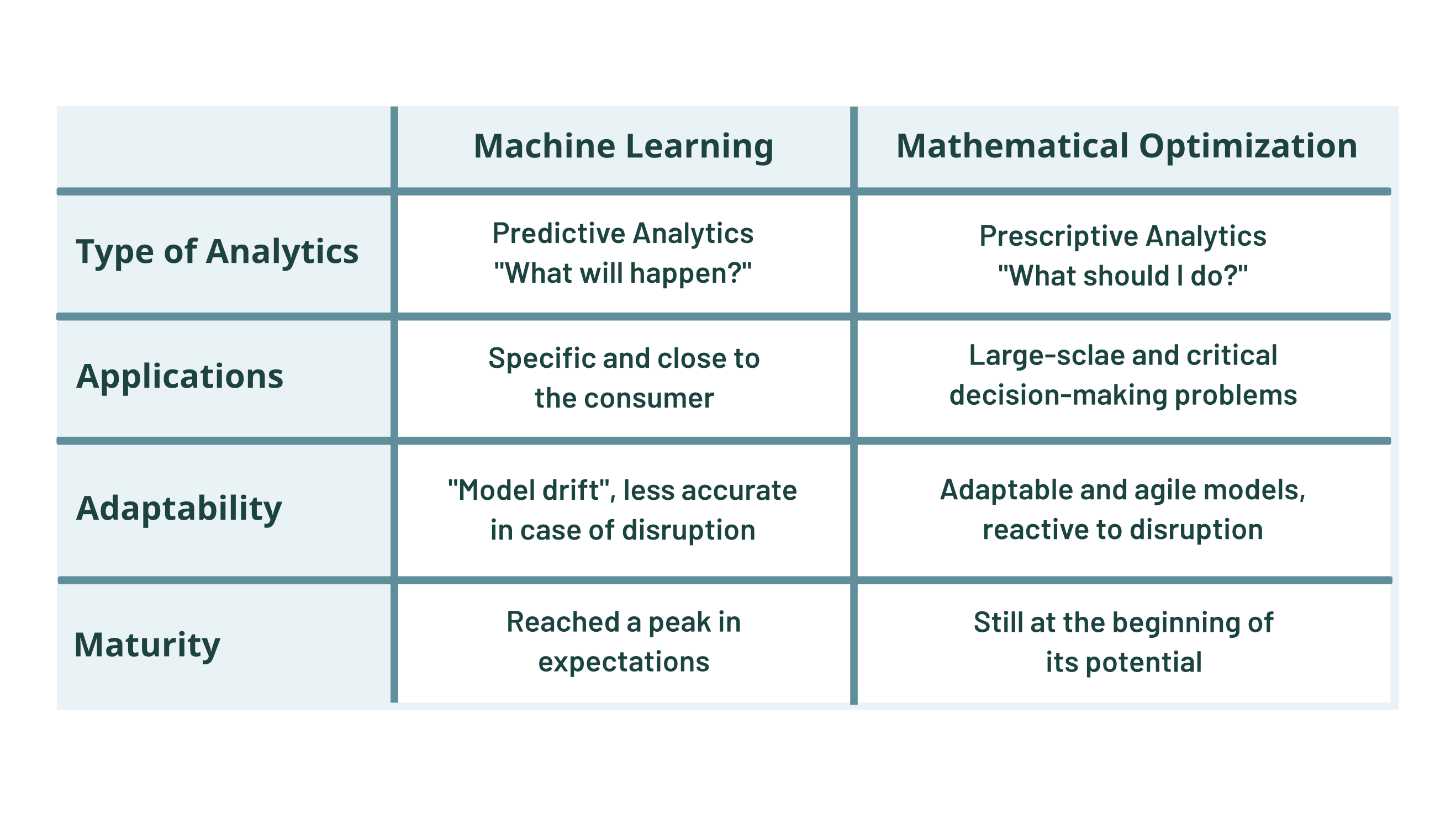
Learning-based AI and decision-making AI are fully complementary. They can be used separately or combined — learning models can enrich the optimization model, for instance. The right choice mainly depends on the use case.
Learning-based AI is often used to offload repetitive, low-value tasks from human teams. Decision-making AI — embodied by optimization solvers — is particularly well suited to complex, high-impact decisions that structure operations.
In practice, there are four main differences between mathematical optimization (the foundation of Atoptima’s solvers) and Machine Learning (commonly associated with learning logics). That’s why, when choosing AI to improve decision-making, it’s essential to look closely at the underlying technology.
B. What makes a good optimization solver?
Once you’ve chosen the AI approach, the next step is selecting the tool. Three core criteria usually matter most.
Functionalities
A solver’s functional coverage determines not only whether it can evolve as your constraints and objectives change, but whether it can address your real problem — rather than a simplified version of it.
Ask yourself:
- Do I need to lock in some decisions before running the solver?
- Do I have to split the problem into sub-problems (by region, by resource, by time period)?
- Do I need approximations for critical input data?
- Do I have to manually adjust the output afterward?
If you’re answering “yes” to several of these, you’ll likely get far more value from a solver that can handle those realities natively in one integrated model — because the productivity gains will be significantly higher.
Adaptability
First, adaptability in modeling, before deployment: can the solver represent your problem faithfully, including nuances such as hard vs. soft constraints, and can it optimize across decisions globally (e.g., palletization + loading + routing within a single framework)? Can the same solver support strategic, tactical, and operational decision-making?
Second, adaptability in day-to-day use: a strong solver should be highly parameterizable and genuinely serve the human decision-maker. The real shift is moving from telling the solver what you want it to output (“I want solution ABC, so I set XYZ”) to telling the solver what you want to achieve under which rules (“I want the best outcome for objective ABC, while respecting constraints XYZ”). In short: from hard-coding outcomes to steering by objectives and constraints.
Performance
Performance has two dimensions: solution quality and computation time.
- Solution quality is the ability to produce feasible plans that respect all constraints — at the lowest possible cost. Even on “simple” problems, different solvers can produce plans with meaningfully different cost outcomes.
- Computation time is tightly linked to scalability. In combinatorial optimization, complexity grows exponentially as the problem gets larger. On big datasets, advanced algorithmic strategies are required to keep runtimes reasonable.
C. Step-by-step: key implementation stages
1) Identify the use case where decision-making AI will have the biggest impact.2) Standardize the data strictly required for optimization (tasks and resources).3) Remove hand-fixed decisions to unlock synergies through optimization.4) Integrate an optimization solver based on the criteria above.5) Capture productivity gains of around 30%.
Decision-making AI can be introduced progressively, without immediate software integration. A practical first step is a study phase: Atoptima builds the mathematical model of your problem and runs the solvers internally to generate solutions. From there, the tool can be deployed within your organization and expanded to cover more decision layers — unlocking the full potential of optimization intelligence through a systemic approach.
If you have resources - vehicles, containers, production lines, people — to allocate and schedule, decision-making AI can clearly improve operational performance. Economic and environmental objectives can align, and decision-support tools like these can even offset the additional costs of the sustainability transition.
With over 25 years of expertise in mathematical optimization, Atoptima stands out for performance and scalability, with tools up to 40 times faster than typical market solvers. It tackles the most complex operational constraints—cases where no other viable alternatives exist.