
Transport planning: Atoptima integrates a cross-functional AI into its Galia interface to interact directly with its solver
Rather than a conversational assistant, the software provider specializing in optimization solvers for transport and logistics has chosen to embed AI at the core of its platform, across the entire planning cycle. The optimization solver remains solely responsible for computing the plan and for its mathematical quality.
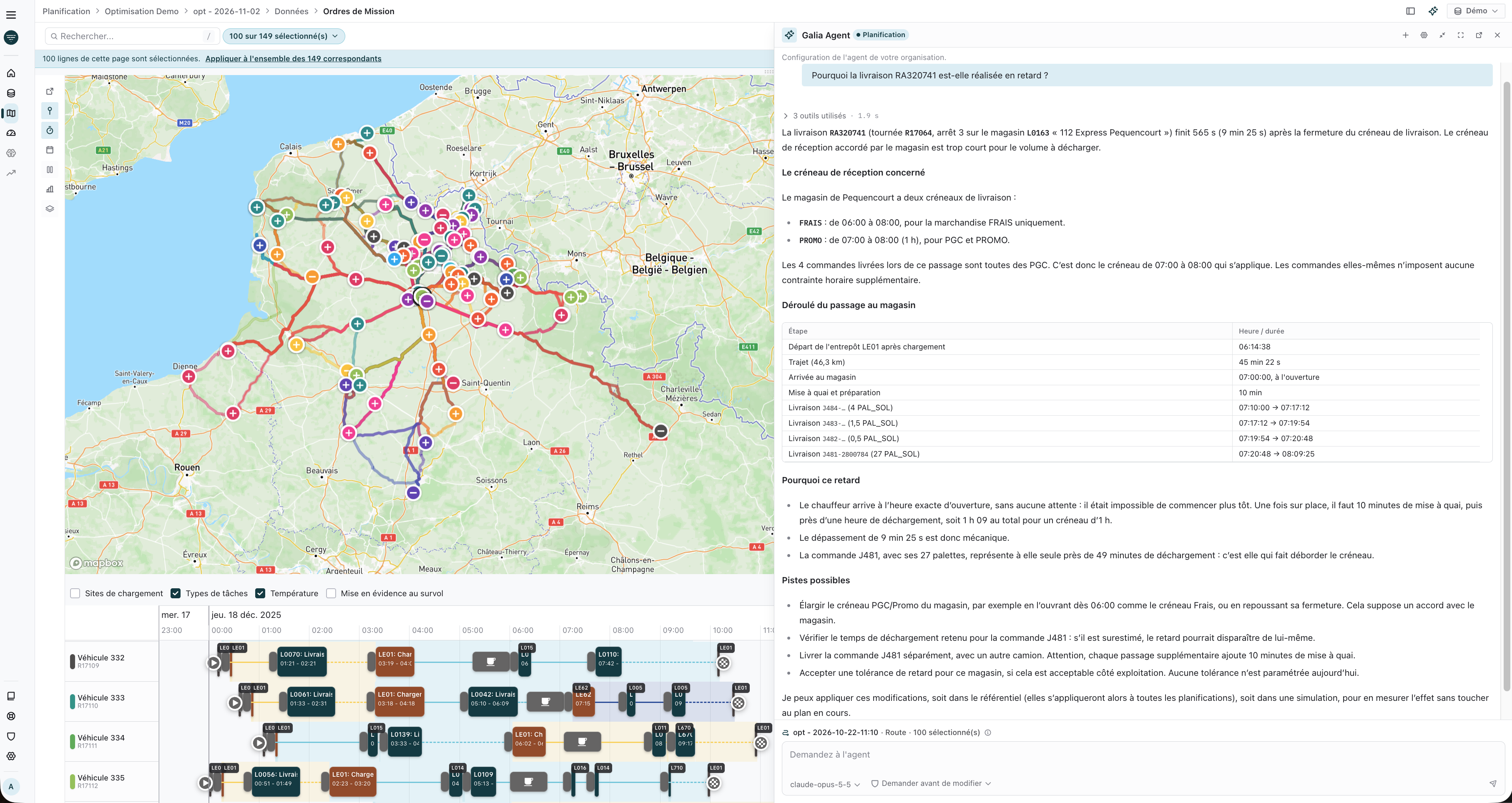
Atoptima is enhancing Galia, its transport planning platform, with an AI agent. Connected directly to the optimization engine, the agent can create a plan, run a computation, change parameters or explain a result from instructions expressed in business language. At the first customers using this AI, analyzing a solution is ten times faster than a manual analysis.
AI built into the whole ecosystem rather than an add-on
Several supply chain software providers have recently announced AI assistants in their products, most often focused on conversing with the user or on one specific step of the process. Atoptima made a different choice: a cross-functional AI that operates across the entire planning cycle, from data preparation to results analysis. The AI interacts directly with the solver and its data model, removing friction both upstream and downstream of the computation.
For example, when asked “The South agency’s semi-trailer broke down this morning: reassign its deliveries while disrupting the other routes as little as possible”, Galia creates a copy of the plan, removes the vehicle, reruns the solver and presents the results within seconds. Every change is submitted to the planner for approval, and the planner stays in control of the solver’s settings.
“Our job is to compute the best plan while respecting every single business constraint, and that responsibility remains with the solver. On the other hand, everything around it can go much faster with AI: preparing data, driving the engine, understanding its choices, reacting to the unexpected. Placing AI at that level was made possible by building a full integration rather than designing yet another component. In fact, we didn’t give the agent a name: it isn’t an assistant, it’s Galia answering,” explains Adrien Duruisseau, COO of Atoptima.
Three main uses
Explainability: understanding and validating the solver’s choices
“Why wasn’t order X included in the routing plan?” Galia explains the trade-offs made by the engine, summarizes the solution and flags points of attention. The planner can therefore validate the plan with full knowledge, step by step: this brings a real understanding of the result, with an iterative and interactive construction of the plan. The solver is no longer a “black box”.
Simulation: driving optimization in business language
“Add order X to the plan without adding an extra vehicle. You can be more flexible on the time windows of customers A and B, but keep strict time windows for all other customers.” Galia translates the instruction into parameters and reruns the optimization. It can also run simulations of alternative scenarios and compare them, for both tactical and strategic planning.
Interfaces: streamlining the whole planning cycle
Galia integrates even more easily with existing systems (ERP, TMS, WMS…), converts customer data into the format expected by the solver, enables replanning up to the last minute when disruptions occur, and produces custom KPI dashboards on demand.
Your choice: Atoptima’s AI or any AI agent
In Galia, users can work with the AI provided by Atoptima or use their own AI agent, whatever it is, through a connector based on the open MCP (Model Context Protocol) standard. They can then use the solver from their usual tools and stay in control of the AI that accesses their data. Galia keeps only two things: the customer’s AI key, if they use their own, and the context they choose to provide (vocabulary, business specifics, instructions).
“Planners no longer need to go through technical configuration: they say what they want, in their own words, and the system carries it out. They get an optimized, explained plan, with the solver’s trade-offs and recommendations, and they stay in control at every step. When a disruption occurs, replanning takes only a few seconds. And it becomes very easy to produce a detailed BI-style report on a transport plan produced by Galia,” adds Vitor Nesello, CTO of Atoptima.
About Atoptima
Based in Bordeaux, France, Atoptima develops a suite of new generation optimization solvers for the supply chain: transport plans and routing, 3D loading, warehouse picking and slotting. Its Galia platform enables business teams to model their constraints as close as possible to field reality and obtain optimized plans at strategic, tactical and operational levels. Built on more than 30 years of expertise in mathematical optimization, its solutions are used by retailers (E.Leclerc, Carrefour, Gedimat), manufacturers (Air Liquide, Repsol), logistics service providers (STEF, CEVA Logistics, FM Logistic) and consulting firms (BCG, PwC).
Press contact
Eva Payet – Marketing Manager – eva.payet@atoptima.com